Meet Sutter Produce Co
From Garden Rows to a Commercial Kitchen: The Story Behind Sutter Produce
(EST. 2006; Sutter, IL)
On the same property where the Knoche family once gathered for a wedding in 2004—held on the front porch of their 1865 farmhouse—now sits a thriving center for local food production. The land is home to high tunnels and a greenhouse, as well as the commercial kitchen where Julie Knoche runs Sutter Produce, founded in 2006. The expansion that then came in 2019 was a dream turned into reality.

Front Drive to Sutter Produce
A Garden Full of Possibility
Julie’s story didn’t begin as a business, it began as a garden. She started growing produce, as a way to help feed her family and offset the rising costs of supporting a large blended household; which slowly grew into something more. As the garden was expanded, this also reshaped how the land was used. The consuming growing space reduced mowing needs, turning maintenance into production.
Julie and her husband grow various fruits and vegetables. Much of the produce she cans into relishes, jams, jellies, pickles and other preserves, as well as, pie-fillings and take-and-bake pies;
Before she ever sold a product, Julie spent time at farmers markets simply observing—learning how small businesses operate and how customers make decisions. That exposure became the foundation for what came next. She started with jams, a staple in her home. These being made from the fruits that were already established in their backyard when moving in, felt more than ideal.
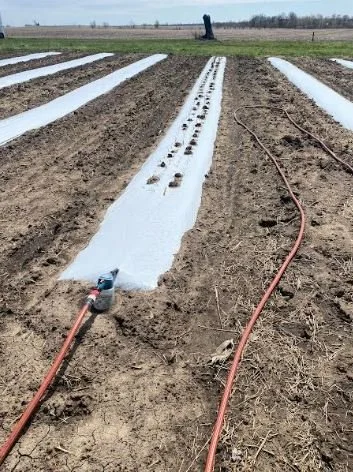
Early Stage of growth coming through plastic, laid to work as a weed suppression
Rooted in Faith and Community
One of Julie’s first entries to selling came through those same markets, where community relationships played an important role. Friendly vendors and early connections helped guide her forward.
Julie shared a story from one of her first farmers markets as a vendor, “a group of Amish women selling fresh bread would send their customers directly to me for jam to pair with their baked goods; saying it was very good though they hadn’t even met me yet”. Those early exchanges helped establish her presence as Sutter Produce became formalized.
Julie often describes her work as shaped by faith, believing that God has opened doors at the right times throughout her journey. That sense of timing and trust has influenced many of her decisions as the business has grown, Julie shared… in relation to finding the property her and her husband reside, garden expansion and during the search for the mobile home — turned commercial kitchen.
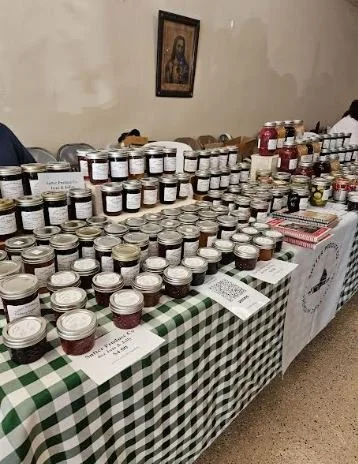
An early market Julie attended with Great Success
Investing in the Vision
As her efforts expanded, her husband initially questioned the speed of growth and investment, (as Julie was still working full-time in another role)! Saying, “the gardens are too big!” Over time, that uncertainty turned into shared pride as the operation became a meaningful family achievement. Julie’s husband, Ron shared his pride for his wife, “At the end of one of Julie’s loooong summer days, I’ll come out to the kitchen and see the big table, lined with the canned jams. It is rewarding to know that all came from our land.”
As mentioned the commercial kitchen - the major turning point came when Julie pursued formal support to grow her work. With help from the Carthage Farm Bureau manager, she applied for and received a $10,000 Hancock County Economic Development grant in 2019. That funding helped establish the commercial kitchen on the property; much needed to meet the demands of her grown produce. Through the Farm Service Agency, Julie also learned about USDA Small Farm Microloans, which further supported the transition from less-formal garden production to a structured business. Julie now is full-time owner and operator of Sutter Produce LLC.
The kitchen itself carries its own history. It operates out of a modular home that was transported down the river from La Grange and repurposed into a functional, open workspace for food production. Its structure reflects the business itself—adaptive, resourceful, and built from what was available.
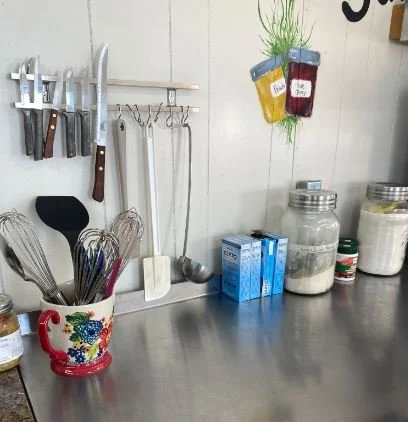
Commercial Kitchen Set-up
Farming Practices behind the products
How the Farm Comes to Life: The work behind Sutter Produce doesn’t really have an “off” season—it just changes with the weather.
In the quiet of winter, when most things still, Julie and her husband are already outside, pruning blackberry and raspberry plants. It’s careful, patient work.
As the seasons begin to shift, the farm slowly becomes more active. Still time before anything is planted, long strips of plastic are laid across the fields, holding in warmth and keeping weeds at bay. It’s a simple step, but an important one, especially for crops like onions, and potatoes that will soon take root there. Inside the greenhouse, things are already growing. Julie starts her tomato and pepper seeds early, tending to them while it’s still too cold to plant outside. This structure uses drip-tape for irrigation as well as trellising for disease control. By the time the weather finally warms, those small seedlings are strong and ready, giving them a head start that carries through the rest of the season after transplanting.
The Heart of Harvest Season: Summer arrives quickly—and with it, the busiest time of year. The pace picks up, and the days stretch. Julie brings in a neighbor and a local high school student to help keep up during peak season , whether that means working in the garden or lending a hand in the kitchen.
When the harvest starts to slow, nothing goes to waste. Extra produce is carefully frozen, saved for the colder months when Julie returns to the kitchen to make jams, jellies, and relishes.
Everything she makes starts close to home. The fruits and vegetables come either from her own land or from nearby neighbors, people she knows and works alongside. For Julie, buying local isn’t just a preference— She actively encourages buying local, emphasizing that, “it keeps value circulating back to the farms and families that produce the food in the first place”.
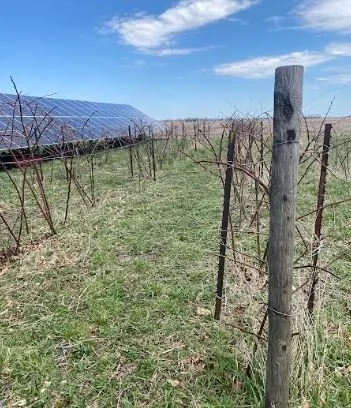
Pruned Bushes - Raspberry & Blackberry
The Art Behind the Jam:
Julie shared the importance of community to her operation, she has opened her space to the next generation, hosting school groups for tours of the commercial kitchen. These visits reflect a shift in purpose: what began as feeding her own family has expanded into feeding her community and beyond. This also narrows the gap between farmer and consumer and gives exposure to the presence of agriculture to youth in the community.
In an interview, Julie also spoke about what makes her products stand out: a strong emphasis on quality, care, and time. “Each batch of jam is made with careful attention to flavor balance and texture, made second to none, ensuring a product that meets a specific standard every time”. That precision is part of what she sees as the responsibility of small-batch production, focusing on quality over quantity; making jam for just 9, 8oz jars at a time. Julie samples each batch to get perfection in her flavor!
If asked to pick a favorite, Julie will tell you it’s her strawberry jam. Her husband, on the other hand, leans toward triple berry or raspberry—a small detail that reflects the personal, family-rooted nature of the business behind the labels.
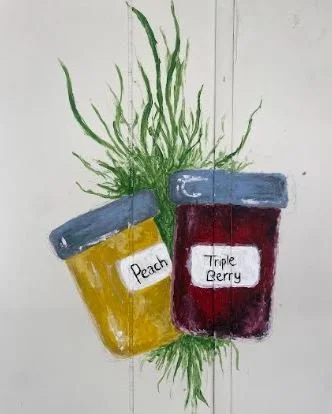
These Special hand-paintings add emphasis to the walls of the commercial kitchen
Still Grounded, Still Growing
Today, Sutter Produce has expanded far beyond its beginnings, with products reaching markets across Illinois, Iowa, and Missouri. But even as it grows, the heart of it hasn’t changed. What started as a garden built out of necessity has become something much larger—still grounded in hard work, community, and a steady, thoughtful way of growing. The operation was built on community ties, resourcefulness, and steady, intentional growth and continues to pursue those attributes.